
 PersistIQ
Leadership programs focus heavily on external skills like strategy and project management, but they miss the foundational core: deep self-awareness. True self-awareness isn’t a fluffy buzzword; it’s the internal anchor that dictates how a leader behaves when under pressure, making it the highest-value capability an executive can cultivate.
Consider how much attention has been given to the surface building of your leadership. Speaking well. Managing up. Building agreement across teams. Useful skills, all working on the surface.
Then someone questions a decision that took weeks to make. And the careful language and skills from the workshop stay stuck somewhere behind the ribs while something sharper comes out instead.
That gap between knowing and doing has a cause, and most leadership training never names it. Self-awareness for leaders determines whether other skills show up when the room gets hot.
Why Good Frameworks Still Fall Apart
Corporate culture operates on a simple assumption: teach people the right framework, and they will apply it correctly. But experience proves otherwise.
Picture a manager who has the whole feedback model down. The structure, the phrasing, the timing. What the model cannot account for is what the manager wants from the room. If they want the team member to keep liking them, and most people do, the message comes out so softly that nothing lands. If the team member’s talent feels like a threat, the same message comes out with an edge. The method was there, but the self-awareness was missing.
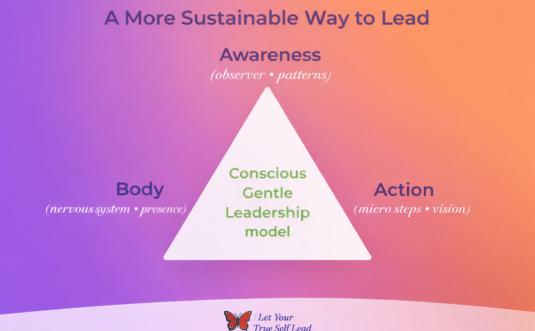
Conscious Gentle Leadership asks for more than technique. It asks about the person using it.
What Leading Without Self-Knowledge Costs
The thing is. The bill arrives whether anyone reads it or not!
First, inconsistent behavior drains workplace trust: warm one afternoon, reactive the next. This makes teams feel unsafe. Employees start managing around the leader instead of collaborating openly.
Second, it burns unnecessary energy. Running on unexamined stress requires constant effort to control outcomes. People end up working much harder while achieving far less.
Finally, it ruins alignment. Professionals build careers that look successful from the outside, but feel empty inside. They hit their goals and wonder why the achievement brings no peace.
What Self-Awareness Actually Looks Like
Vague advice like “be authentic” or “stay present” offers very little practical help. Useful leadership self-awareness breaks down into three concrete layers:
| Triggers | Patterns | Impact |
| Identifying the specific situations, comments, or behaviors that trigger instant defensiveness. These reactions reveal unexamined assumptions and unmet needs. | Recognizing default stress habits, whether that means withdrawing, micromanaging, or pleasing people. Seeing these routines opens up real choices rather than automatic reactions. | Seeing the actual effect on team members rather than relying on good intentions. The space between what a leader intended and what a team experienced is where most friction occurs. |
Building this skill is an active, ongoing effort. It comes down to learning to respond rather than react.
What the Body Has to Do With It
There is biology under all of this. When you feel threatened, socially or otherwise, your nervous system goes into protection mode. The part of the brain that handles careful thought goes quiet while faster, older systems take over. Those systems are built for speed rather than nuance, which is why capable people make poor calls under stress.
Self-awareness creates the pause where you notice the shift. Shoulders rising. Breath going shallow. Thinking is narrowing to one option. Catching that early gives you a chance to settle before you speak. Miss it, and biology decides for you.
The Gentle Leadership Model works at this level because surface tactics cannot reach it. Leading differently means settling differently, and settling differently means knowing what needs settling.
Starting From Where You Stand
The starting point is plain observation, done regularly.
Step One: Start with your Body.
Tension, breath, posture. Those signals usually move first, and most leaders have trained themselves to ignore them.
Watch your Fast Reactions.
The instant irritation. The quick dismissal. The urge to fix. Those moments carry data.
Ask for Feedback Carefully.
Find two people you trust and ask what you are like to work with on a hard day. Listen without explaining yourself. The space between their answer and your self-image is where growth lives.
And consider working with someone trained to spot what you cannot. Transformational coaching exists for that, less to hand over answers and more to help you reach your own.
Access The Leadership Skill That Shapes Every Other
Leadership education has long favored what can be listed, scored, and rewarded. These tactics that look great on resumes, fit neatly onto slide decks, and map cleanly to performance reviews.
Even though self-awareness is one of these skills, it will never be the headline of a conference. Nobody handed you this chapter; that was the curriculum’s gap, not yours. Ready to look at the layer underneath your leadership skills? A conversation with a transformational leadership coach is a place to begin.
Common Questions About Self-Awareness
How can someone tell if their self-awareness needs work?
A key sign is repeated surprise at how others react to your style. If feedback consistently conflicts with your self-perception, it indicates a clear blind spot. Another indicator is encountering the same interpersonal conflicts across projects, roles, or organizations.
How fast do the results show up?
Initial shifts, such as pausing before answering sharp questions or noticing physical stress cues, often emerge within weeks. Fundamental changes, such as shifting deep-seated coping habits and transforming your relationship with stress, take steady focus over several months.
Book Your Transformation Session Today
Disclaimer: We are passionate about sharing insights, tools, and reflections to help you cultivate conscious, gentle leadership and inner alignment. However, the information shared on this blog is intended solely for educational and inspirational purposes. It is not a substitute for professional mental health therapy, medical advice, or psychiatric care. If you are experiencing psychological distress or trauma, please seek the support of a licensed mental health professional. We are here to guide your personal growth, but your overall well-being and safety must always come first.



[…] have described this as genuinely not knowing the answer anymore, which is what happens when your own needs go unconsulted for long […]