

 PersistIQ
If you’re highly successful but feeling unfulfilled, it’s a sign that your current achievements don’t align with your true self. True professional alignment comes from moving past constant external validation to cultivate deep internal clarity.
Successful on the Outside and Empty on the Inside
Picture the standard corporate baseline: the corner office views, the seamlessly tailored wardrobe, and the calendar booked solid with high-stakes decisions. To the rest of the world, this is the definitive portrait of success. Yet, inside, there’s an entirely different narrative.

Society doesn’t prepare high performers for this specific paradox. When you’re successful but unfulfilled, the standard advice tells you to buy something new, change your corporate scenery, or hustle harder.
But you can’t fix an inside problem with outside rewards. That empty feeling isn’t a failure; it’s just your nervous system trying to tell you something.
We’ll Break Down
- Why external milestones fail to create internal peace.
- How childhood survival patterns drive high-achiever burnout.
- Moving your leadership style from pressure to presence.
The Gap Between Achievement and Fulfillment
Society teaches a massive lie: that achievement and fulfillment are the same thing.
The traditional playbook says to set a goal, sacrifice your personal life to hit it, and wait for the happiness to arrive. When happiness never shows up, the playbook offers a simple solution: set a bigger goal. Get a grander title. Move to a larger company. You keep accelerating, but you never actually arrive anywhere.
The distinction is simple: Ambition is great for building companies, scaling projects, and creating wealth. But external success is measured by numbers and recognition. Those things have practical value, but they cannot make you feel alive.
It’s a heavy feeling when a career looks perfect to everyone else but leaves you feeling empty inside. It usually means there’s a painful disconnect between the life you’ve built and who you truly are at your core.
Why High Achievers Often Feel Empty Despite Success
The Origin of the “Prove Yourself” Loop
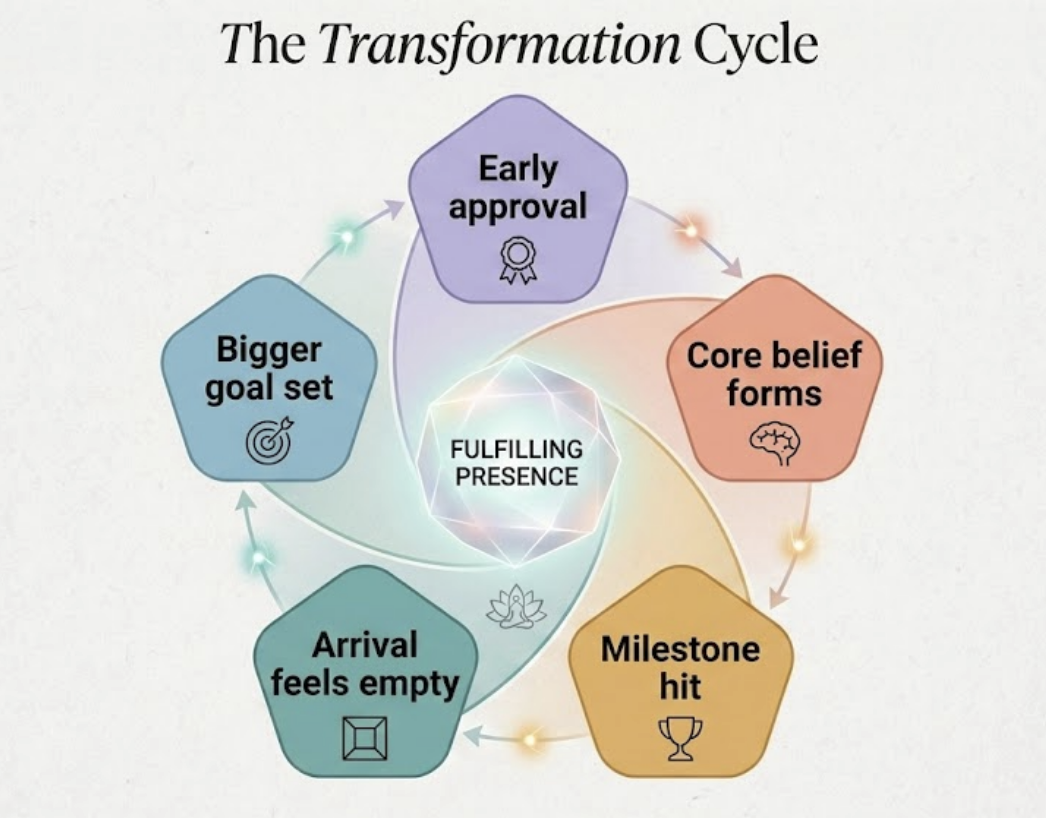
Most driven professionals learned early in life that approval was tied to performance. The lesson was subtle but powerful: you are safe when you succeed. You are valuable when you exceed expectations. You are worthy when you win.
Over time, this becomes your internal operating system. Your brain tells you that the next milestone will finally unlock the permission to relax and feel secure.
The real trap is looking for a sense of ‘enough’ in a system that’s designed always to want more. We pour our hearts into these big professional goals, secretly hoping they’ll give us the emotional validation we’re starving for. Honestly? It’s a dead end. A corporate balance sheet is never going to love you back. But… the good news? You don’t need it to.
The Cost of Constant Acceleration
In elite circles, high achievers’ burnout rarely looks like a dramatic breakdown. Instead, it looks like:.
What “Feeling Empty Despite Success” Is Telling You
The most sensible reaction to an internal void is to change something big and to change it quickly. Launch a new company. Switch industries. Rewrite the organizational chart. Anything that shifts the external landscape enough to quiet the internal one.
Changing jobs or taking a vacation can help for a minute, but the real issue is rarely something you can fix easily. Instead of trying to force that emptiness away or treat it like a flaw, try looking at it as a map. It’s just showing you where you need to heal.
More Effort Isn’t the Answer
Here’s the catch: if you’re used to brute-forcing your way through challenges, this is going to feel totally alien.
You can learn to stop leading from anxiety, control, and the constant need to prove your competence. You start leading from clarity, alignment, and a deep trust in your own judgment. This is the foundation of Conscious Gentle Leadership. This approach allows you to make high-impact decisions from a place of absolute clarity rather than reacting to chronic stress.
What Does The Other Side Of This Transition Actually Look Like?
Making decisions without panic

Leadership transitions from a reactive game of whack-a-mole to a deliberate game of chess. You make choices based on data, vision, and deep inner clarity, completely free from that familiar, frantic fear.
Resting Without Guilt
Sunday afternoons stop feeling like an unauthorized absence from your desk. You no longer hear a lingering voice whispering that you should be auditing a spreadsheet or answering emails.
No Longer Needing Constant Praise
The reliance on external applause evaporates. Because your internal foundation is solid, a compliment becomes pleasant feedback rather than a necessary life-support system for your self-esteem.
Feeling Internally Steady During Uncertainty
When market dynamics shift or corporate reorganizations hit, you remain anchored. The external chaos stops triggering an internal earthquake because your identity is no longer tied to things you cannot control.
This transition takes practice, and it starts with a few deliberate changes to your daily rhythm. When you’re ready to transition your career from pressure to presence, our specialized leadership methodology is ready to support your growth.
What You Might Be Wondering Right Now
Is it normal to feel completely unfulfilled when reaching the peak of my career?
Yes. This specific disconnect is incredibly common among top-tier professionals. External achievement and internal fulfillment run on completely different tracks. You can maximize your market success while the systems that drive personal satisfaction remain totally offline. This does not mean something is wrong with you. It means your internal operating system needs a completely different input than validation to function correctly.
Does an internal void mean a career pivot or quitting a job is necessary?
Not necessarily. While some work environments are toxic, the primary breakdown is usually internal. If you move to a new company without changing the underlying habits, like the need to prove your worth through overworking, the same patterns will repeat in your new role.
What is the actual process for uncovering an authentic purpose?
Uncovering purpose is about subtraction, not addition. The process requires identifying and removing the layers of corporate conditioning, social pressure, and defensive habits you built over your career. Utilizing a structured, specialized methodology designed for internal alignment provides you with the framework to navigate this clearing process efficiently.
Can a structured coaching framework fix deep internal misalignment?
Yes, if the methodology moves past surface-level goal tracking and tactical career advice. You can’t just think your way out of being stuck. True breakthrough requires three things: retraining your mind, calming your nervous system, and realigning your habits.
The focus is on guiding you to recover and trust your own internal metrics of success. To see how this specific framework operates, look into the details of the Transformational Life and Conscious Leadership framework.
Disclaimer: We are passionate about sharing insights, tools, and reflections to help you cultivate conscious, gentle leadership and inner alignment. However, the information shared on this blog is intended solely for educational and inspirational purposes. It is not a substitute for professional mental health therapy, medical advice, or psychiatric care. If you are experiencing psychological distress or trauma, please seek the support of a licensed mental health professional. We are here to guide your personal growth, but your overall well-being and safety must always come first.